
Since 2025, I have been part of the work the Alma Foundation carries out at the “Clara Parada de Pinto” Higher Teacher Training School. During this time, I met María Daniela, a fourth-year deaf student specializing in Early Childhood Education. Her journey caught my attention due to the perseverance with which she has faced various challenges throughout her life and her studies to become a teacher.
At 43 years old, Daniela has traveled a path marked by various challenges in accessing education. During her childhood, given the lack of specialized institutions for deaf people in Trinidad, her family sought alternatives outside the city and later spearheaded the creation of IDEPPSO-BENI, an institution dedicated to the educational needs of deaf individuals. Daniela learned to communicate orally and later adopted Bolivian Sign Language; these experiences gave her firsthand insight into the educational barriers faced by deaf people. This journey motivated her to enroll in the Higher Teacher Training School to become a teacher and contribute to inclusive education.
During her initial months of training, she faced significant communication difficulties due to the absence of support teachers. Despite these limitations, she was supported by her mother, classmates, and instructors, who sought ways to facilitate her participation and learning. Later, the arrival of an interpreter-teacher made a significant difference, allowing her to participate more easily in academic activities and continue progressing in her training.
While completing her teaching practicums, Daniela deepened her interest in the profession and observed firsthand the difficulties deaf students face in accessing learning. This experience allowed her to recognize the barriers that still exist and motivated her to seek ways to overcome them. In this context, she was introduced to Fundación Alma’s pedagogical strategies during our workshops. She showed particular interest in visual and participatory approaches—such as “Image Sequences” and “Sets”—incorporating and using them during her practical training because she viewed them as resources that could foster her students’ understanding and participation.
Looking ahead, she aspires to work at IDEPPSO-BENI and develop educational materials adapted to Bolivian Sign Language, aiming to help reduce barriers and improve learning opportunities for deaf children.
Daniela’s story demonstrates that inclusion is also built upon personal experience. Her life goals and vocation offer the prospect that future generations of deaf children will find a teacher in their classrooms who can understand their needs, communicate with them, and show them that no condition need limit their ability to learn and build a future.
By Mariana Ibañez Eguez
Consultant, Fundación Alma-Beni
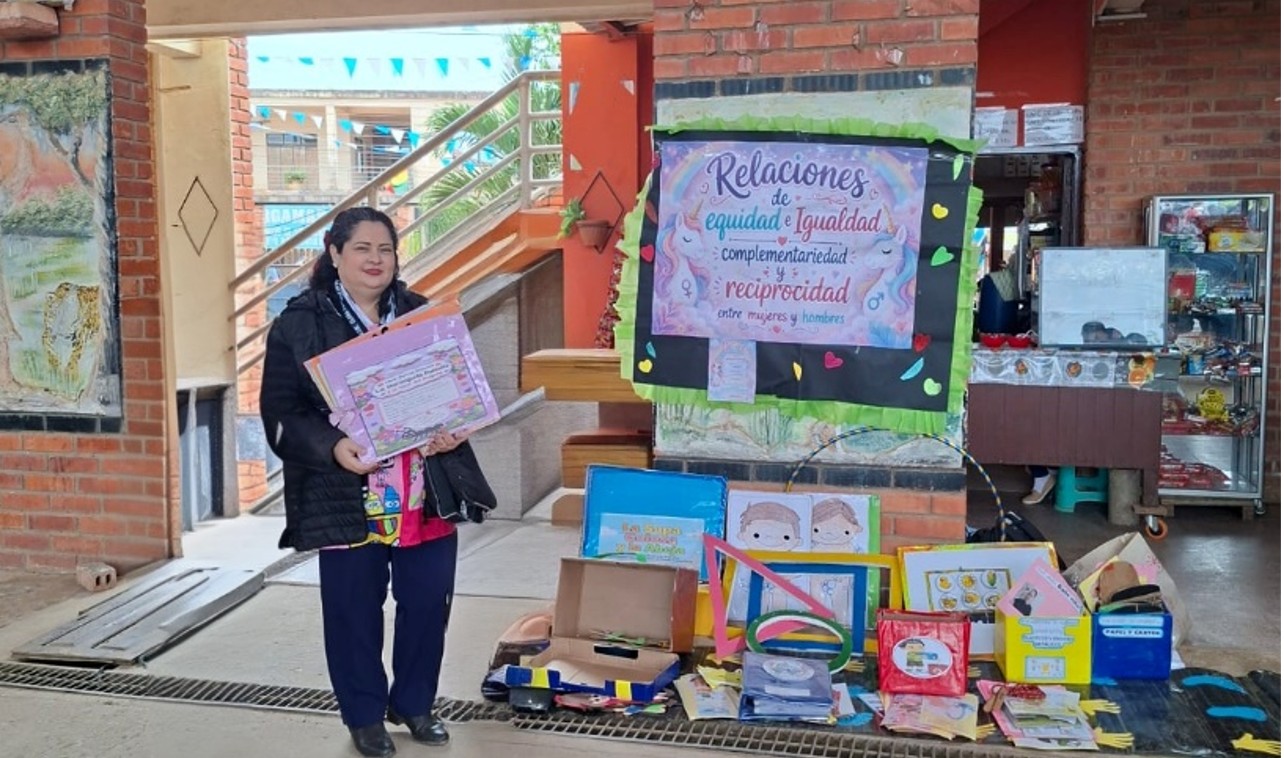
María Daniela Castellanos Barboza