
When María Noelia Rejas had to choose where to complete her educational practicum, she decided to step outside her comfort zone. As a third-year student specializing in Food Processing and Gastronomy, she could have chosen a setting directly related to her field of study; instead, she asked to work at the San Antonio Alternative Education Center with deaf students. She wanted a different kind of experience—to discover how to share her knowledge in a new and challenging context.
She possessed a skill that allowed her to connect with her students from day one: Noelia knew Bolivian Sign Language (LSB). She had learned it years earlier while accompanying Jehovah’s Witnesses on outreach activities with the deaf community. What began as a way to communicate in a different setting took on new meaning during her practicum, becoming the foundation for building relationships with her students.
Upon entering the classroom and addressing them in their own language, she noticed an immediate shift. Gael, Carmen, Rodrigo, and Víctor began to open up and feel more at ease. “When I walked into the classroom and started speaking to them in LSB, they opened up and really began to trust me,” she recalls.
The experience led María Noelia to reflect on the isolation many deaf people face. While they constantly strive to learn the language of those around them, few hearing people make the effort to learn theirs. In the classroom, communicating in LSB was not merely a way to convey information; it was a means of acknowledging her students and letting them know they could express themselves and be understood.
It was upon this foundation of trust that the pedagogical work began. One of the main challenges was preparing the students to participate in the Inclusive Entrepreneurship Fair for People with Disabilities in the Cercado district of Tarija. The activity offered them a chance to showcase their skills, but it also required finding teaching methods suited to each individual’s characteristics and needs.
That was when María Noelia put into practice the pedagogical strategies she had learned at Alma. Instead of relying on a single teaching style, she observed how each student learned and sought out resources that would help them grasp the material, remember the steps, and actively participate in the food preparation.
With Gael, she used a “sets” strategy to facilitate learning the process of making Greek yogurt. With Rodrigo and Víctor, she used flashcards. To teach Carmen how to make hamburgers, she created models and image sequences illustrating every stage of the process.
These strategies were neither mere supplementary materials nor isolated activities; they were the means of transforming technical content into an experience accessible to every student. On the day of the fair, the results of this work became evident: Gael took first place, and Carmen took second. For Noelia, however, the awards mattered less than witnessing the joy with which both students received recognition for their efforts. “More than the prizes, it was deeply moving to see their achievements and to see them so happy,” she says.
The practicum also led to a contribution that could leave a lasting mark on CEA San Antonio. Noelia noticed that certain kitchen machines and pieces of equipment lacked established signs in LSB (Bolivian Sign Language). She therefore worked alongside her students to create signs for them. This was not a translation process she carried out alone; the students themselves participated in defining each sign, drawing on their own experiences and knowledge of the language. In this way, they not only learned about gastronomy but also helped create resources that could facilitate learning for other deaf individuals.
Upon completing her practicum, María Noelia took with her a broader understanding of what teaching entails. She learned that education also begins when a teacher finds a way to connect with their students’ world, recognizes their capabilities, and creates the conditions for them to demonstrate those abilities. Her time at CEA San Antonio lasted only a few weeks, but it left a legacy that extends beyond the classroom: students who felt understood and capable, new tools for continued learning, and a future teacher who was able to turn what she learned at Alma into concrete opportunities for her students.
By: Leydi Osorio Ramos
Tarija Coordinator
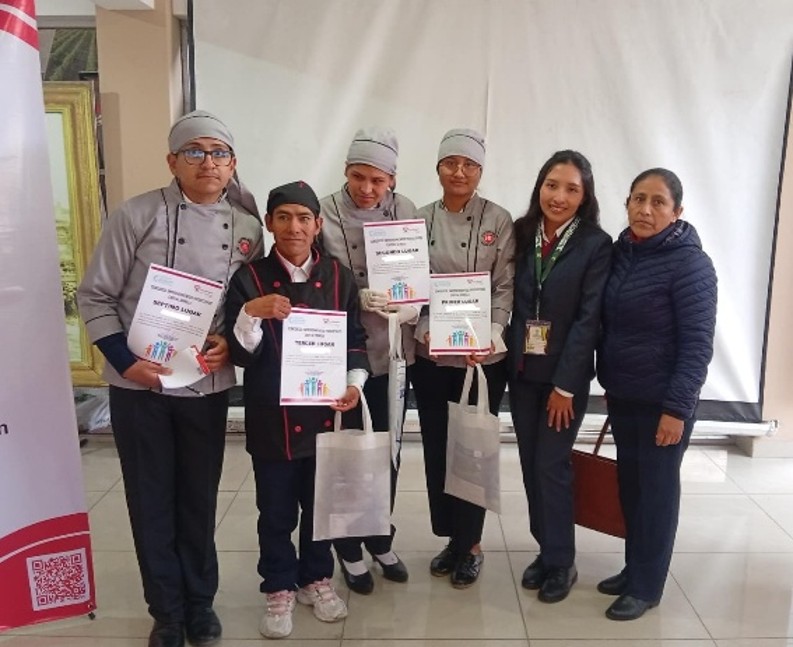
Participation in the Inclusive Entrepreneurship Fair for People with Disabilities
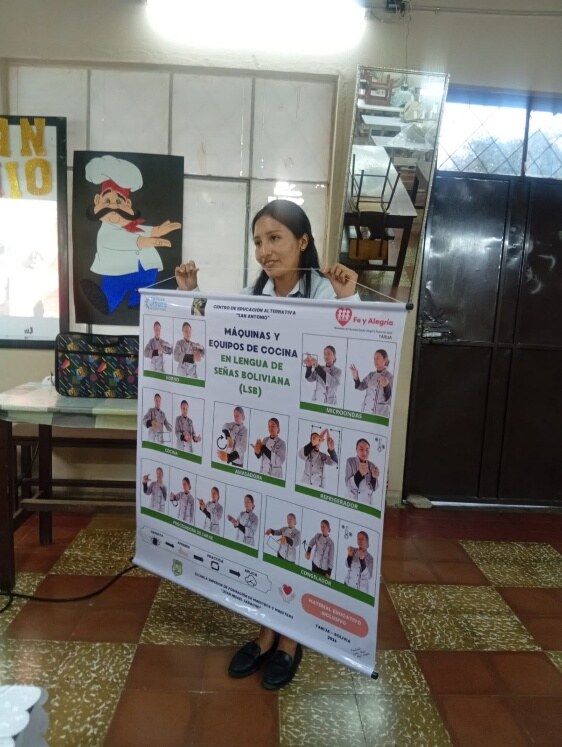
Presentation of the LSB translation for kitchen machinery and equipment names to CEA San Antonio