
In recent days, students from the Higher Teacher Training Schools (ESFM) took to the streets in various regions of the country. In Tarija, they even occupied school buildings. This was not an isolated or improvised reaction, but rather a coordinated national response to what they perceived as a direct threat to the Technical-Humanistic Baccalaureate (BTH), a program that is central to their present and future as teachers.
“We are from the teacher training schools, we are marching in defense of the BTH… it is a powerful march, and it is not only happening here but nationwide,” stated Claudio Choque, national executive of the Confederation of Student Teachers of Bolivia (CEFOM-B). His words reflect a concern that quickly spread among students throughout the country.
The trigger was a directive that proposed evaluating educational institutions offering the BTH, opening the possibility of moving toward the closure or gradual elimination of technical programs. However, beyond the evaluation itself, what generated the most concern was the lack of clarity regarding how these programs would be strengthened or what would happen to those about to graduate.
In an interview with Fundación Alma, Misael Nina, Executive Secretary of the Federation of Student Teachers of Tarija, explains that “it was alarming because it implied the cessation or elimination of the BTH (Technical Training Programs)… there was no mention of restructuring policies to make them viable, nor of how job opportunities would be guaranteed for those about to graduate.” The concern wasn’t just local. In several ESFM (Teacher Training Schools), technical programs constitute the core of the training. “In some schools, there are only technical programs… so the alarm was nationwide,” he points out.
The response, then, was also nationwide. The mobilizations arose from agreements among representatives of different schools, with the objective of sending a clear message to the Ministry of Education. “The mobilization was consensual… it had to be a joint, strong, and decisive action,” Nina explains. But the demand wasn’t limited to rejecting the directive. From the outset, the students proposed a different approach: not to eliminate the BTH (Technical and Vocational Training Program), but to improve it.
“We want it restructured… we want them to consider equipment, improvements, and adjustments to the curriculum,” says Nina. Her stance reflects an idea that runs through the movement: the BTH has shortcomings, but that doesn’t invalidate it; rather, it highlights the need for investment, planning, and support.
This perspective is also shared in other regions. Alex Mario Rojas Paco, a student from Trinidad and representative of the National Confederation for the “Clara Parada de Pinto” Higher Teacher Training School, explains that, although this campus doesn’t have a BTH, they decided to mobilize in support of other regions. “We are part of the same system and we empathize with our fellow students,” he points out, emphasizing that the concern also extends to teacher training in general and the reduction of spaces for technical specializations.
From their experience, the impact of the directive could be profound: “It implies a freeze on training in technical areas… and students in regular education could be left behind, cut off from this training and future job opportunities.” For Rojas, the BTH (Technical and Vocational Training) fulfills a key function in the education system: “It helps high school graduates acquire knowledge that will allow them to have a future source of employment, even if their circumstances prevent them from pursuing a professional degree.”
Both voices agree on a central point: the problem is not the existence of the BTH, but the conditions under which it operates. The lack of equipment, infrastructure, and resources limits its potential. “If educational institutions had better conditions, the learning could be much more effective,” says Rojas, who compares this reality with his own experience in technical training, where they did have the necessary resources.
The protests led to the opening of a dialogue with the Ministry of Education. As a result, it was decided to rescind the initial directive and move toward an evaluation process aimed at strengthening the BTH. The agreement reached raises the need to improve conditions such as equipment, workload and organization of specialties, in addition to considering the continuity of these areas in the educational system.
For the students, this result doesn’t represent an end, but a starting point. “This isn’t just about us… it deserves serious study and real solutions,” Nina points out, emphasizing the importance of maintaining dialogue. Along the same lines, Rojas highlights that this process offers a lesson: the need for educational decisions to be made with the participation of all stakeholders and with clear and timely information.
What has happened in recent weeks shows that the BTH (Technical and Vocational Training) is both an opportunity and a challenge. It has obvious limitations, but also profound value in contexts where technical education can make a difference in students’ lives. In this tension between what is lacking and what it represents, the students of the ESFM (Teacher Training Schools) have been clear: strengthening the BTH is not just a sectoral demand, but a commitment to a more relevant, more equitable education, one more connected to the realities of the country.
By: Andrea Fernández
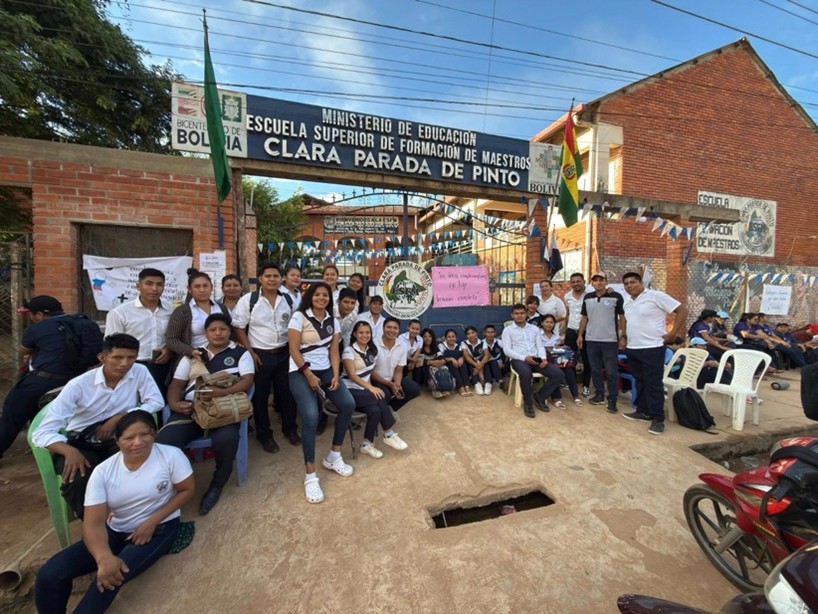
Mobilization in Trinidad ESFM “Clara Parada de Pinto”
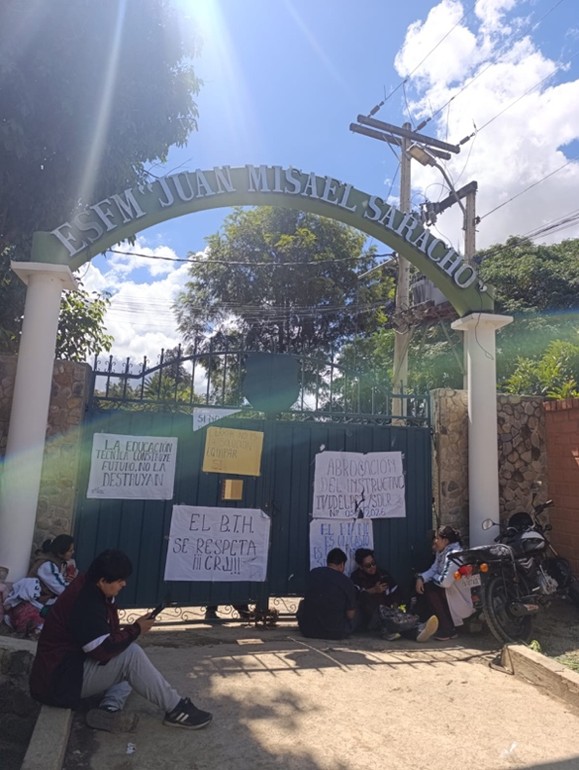
Mobilization in Canasmoro – Tarija ESFM “Juan Misael Saracho”
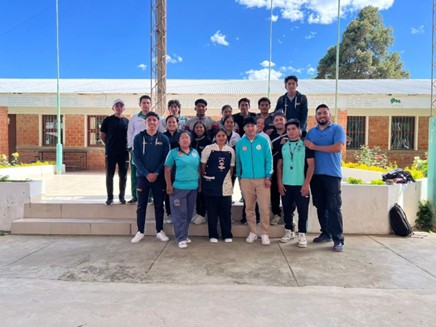
Leadership Federation of Student Teachers
ESFM “Juan Misael Saracho” Canasmoro-Tarija